
01
Use the official technology terminology
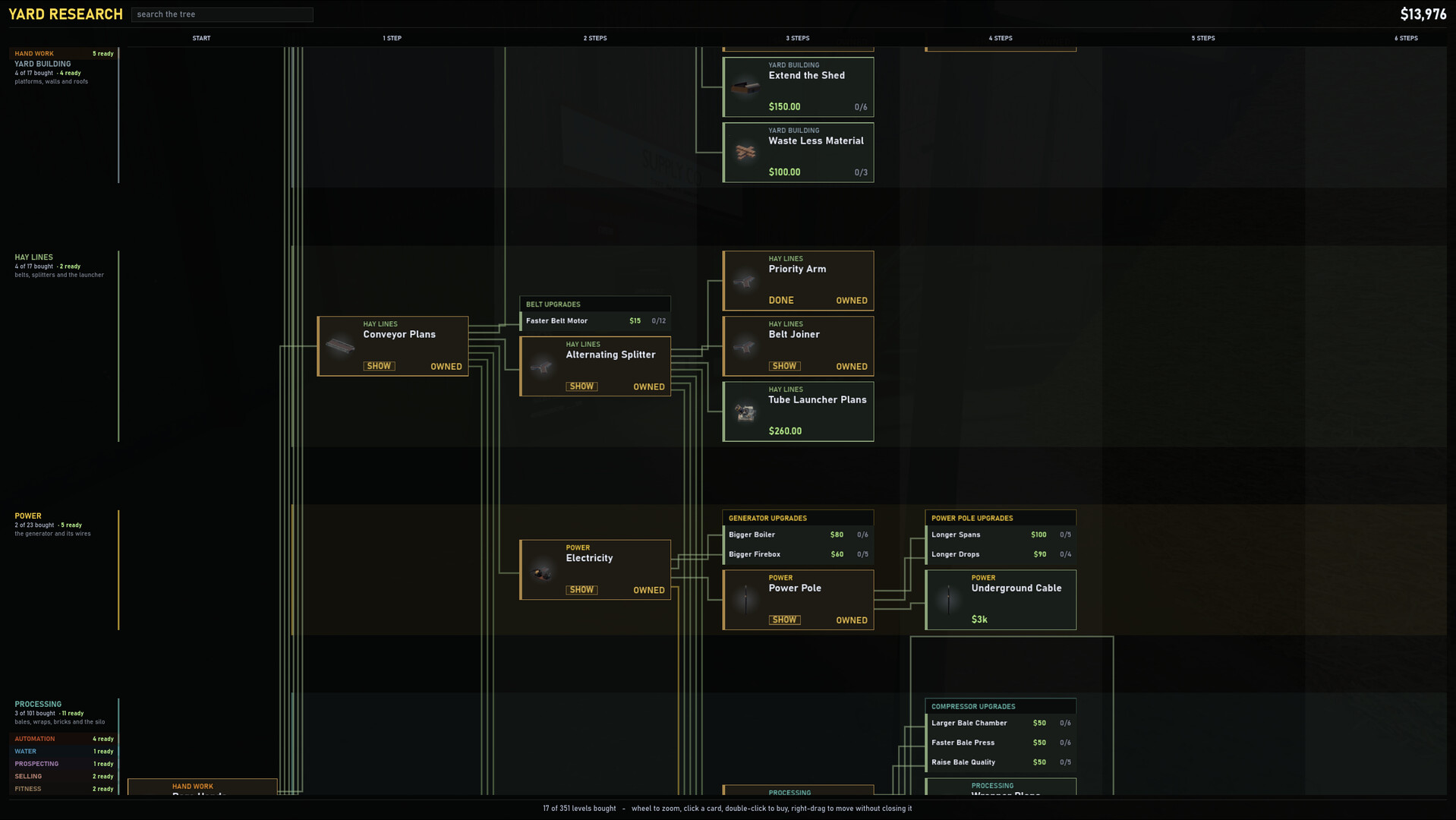
Players may search for a skill tree when looking for upgrades, but the saved Steam description calls this system a Tech tree. It says the tree has more than 300 upgrades and connects them to machines, production speed, efficiency, factory expansion and new ways to process hay. Those are the confirmed categories that form the basis of this guide.
The terminology matters because a factory technology system does not automatically imply character classes or combat style skill builds. Named character skills, passive points, respec rules and a separate character progression system are 待确认 in the saved evidence. As a recommendation, search the current interface for technology and research information rather than expecting a character skill menu based only on the keyword used to reach this page.
02
Interpret the 300 upgrades statement correctly
The official demo store page advertises a huge technology tree with over 300 upgrades. This is a developer statement about the described scope, rather than our own count of individually checked nodes. The saved material does not identify every upgrade or establish how many can be reached in one installed demo session.
Exact node names, demo accessible node count, costs, prerequisite chains and a complete build sequence are all 待确认. As a recommendation, use the large scope as a reason to choose a focused research goal, then inspect the available options that serve it. The advertised number should not become a promise that a particular screenshot, old checklist or third party build covers every current unlock.
03
Match an upgrade category to your problem
The confirmed categories provide several distinct questions to ask when choosing research. Do you want access to a new machine, a change to production speed or efficiency, room to expand the factory, or another way to process hay? The description establishes that these kinds of improvements belong to the tree, but it does not assign them to specific branches or named nodes.
As a recommendation, state the desired change before opening a long list of upgrade options. Compare that sentence with the current node description so the research choice has a job in your operation. A node's position or advanced appearance alone does not establish that it addresses your slowest task, increases needle detection or produces the best financial return.
04
Inspect prerequisites and the whole intended arrangement
A useful research plan includes what you intend to do after acquiring the upgrade, as well as the requirement displayed before acquiring it. The official overview describes buying machines through hay sales and building an operation with power and belts. It does not give a universal dependency map that connects every technology upgrade to a finished factory arrangement.
As a recommendation, inspect the current node description, the available machine information and the requirements of the supporting components before committing resources. Write the planned result in enough detail to understand how the relevant parts are intended to work together. The factory guide supports this planning, while exact compatibility, prices and prerequisite order remain 待确认 wherever the saved sources provide no answer.
05
Keep manual tools and technology connected by purpose
The Steam page separately names shovels, buckets, wheelbarrows, pitchforks and vacuums as tools that help process hay manually. It also describes the move from an opening detector toward belts, balers, scanners and robotic arms involved in later searching. These are useful contexts for research planning, but the text does not establish a node for each tool or a required progression between every named item.
As a recommendation, compare a manual purchase and a research goal according to the work each available option actually describes. You may be investigating a repeated personal task or planning a larger connected process, which are different reasons to spend. The tool progression guide develops that comparison without turning the official list into a guaranteed sequence of unlocks.
06
Evaluate speed and efficiency with readable measurements
Production speed and efficiency are confirmed technology categories, but their exact formulas and node values are 待确认 in the saved text. A saved player question about machine metrics mentions hay per hour and pulp per second, showing why a measurement can be confusing even before research effects are compared. The thread is a request for clearer readouts, not proof of a tested upgrade calculation.
The rate converter can normalize a value you enter to a common time basis for your own comparison. It cannot provide an upgrade's missing statistics or a material ratio between hay and pulp, so preserve both the material name and any unknown values. As a recommendation, compare the same kind of work on the same time scale before attributing an apparent difference to a speed or efficiency upgrade.
07
Research detection without inventing a search branch
The official opening assigns a metal detector to hand work, while the later overview includes scanners among automated searching equipment. That supports reading detection as part of the wider operation, but it does not prove a specifically named detection branch in the technology tree. Detector bonuses, scanner range upgrades, exact search prerequisites and a guaranteed replacement order are 待确认.
As a recommendation, inspect the device information and any relevant current node before assuming that a production upgrade changes needle searching. The metal detector guide and haystack scanner guide separate their confirmed roles and their missing specifications. This allows a research decision to stay tied to an actual described effect rather than a connection inferred from nearby equipment names.
08
Keep a compact technology plan
A compact plan can record the problem, the candidate upgrade, its current requirements and the activity you expect to perform afterward. As a recommendation, add a note identifying which details came from the interface and which are still questions. That makes the plan easier to revise when a new option appears or a requirement changes your immediate choice.
Keep the node's actual wording in that record rather than replacing it with a broad label such as better search or more money. A category like efficiency still needs a described effect before it can explain a specific change to your operation. This makes two possible upgrades easier to compare by purpose, because each candidate remains attached to the activity its own description actually addresses.
After one meaningful change, reconsider whether the original problem remains the best focus for the next research decision. This is a practical planning method, not a claim that we have playtested a complete technology build or found the fastest route through the tree. The confirmed categories and developer scope provide the framework, while the nodes and requirements you can actually inspect supply the next concrete action.
Questions
What players ask
Is the skill tree officially called a technology tree?
Yes. The Steam description uses Tech tree and says it includes more than 300 upgrades. Character classes, passive skill points and a separate character skill system are 待确认.
Are all 300 upgrades available in the demo?
The figure is the scope stated on the official demo store page. The exact number of nodes unlockable in the installed demo is 待确认, and this guide is not a tested node checklist.
What is the best technology build?
A universal optimal build, exact prerequisites and node prices are 待确认. As a recommendation, choose a research goal that addresses the work or production plan you can currently inspect.