
01
Start with the progression the source describes
The official opening puts you in front of a haystack and asks you to find needles, beginning by hand with a metal detector. The broader loop then describes selling hay, buying more machines and receiving a bigger pile. Together these statements establish a move from personal work toward a larger operation, rather than a fully specified shopping list.
This distinction matters because a tool name can suggest a familiar real world function without proving the game's exact implementation. Shovels, buckets, wheelbarrows, pitchforks and vacuums are officially named as tools for manual hay processing. Their capacities, speeds, prices, individual unlocks and relative rankings are 待确认, so use the current descriptions to decide what each available option actually contributes.
02
Give the next purchase a concrete purpose
As a recommendation, observe one complete routine and write down where your own work or the material flow needs improvement. Distinguish understanding the search, handling hay, moving material, processing products and arranging a sale as questions to investigate. The source establishes these broad activities, but it does not measure which one is the limiting step in your particular session.
Turn that observation into a simple purpose for the next purchase, such as reducing a repeated manual task or enabling an available production option. Then compare that purpose with the wording of the tool, machine or research option you can currently inspect. This keeps the decision tied to your own visible problem instead of treating an advanced looking item as an automatic improvement to everything.
03
Read manual tools without inventing a tier list
The Steam tool section says to buy tools like shovels, buckets, wheelbarrows, pitchforks and vacuums to help process hay manually. It does not rank them, assign them to numbered tiers or tell you to purchase every listed item before automation. A verified best manual tool, an exact tool capacity table and a fastest manual route are therefore 待确认.
As a recommendation, compare the action described for each available tool with the work you are actually repeating. Check whether the current interface identifies a requirement, operating method or limitation relevant to that action, then decide whether it fits the intended job. The metal detector guide treats needle searching separately, because the manual hay tool list does not establish detection bonuses.
04
Plan the transition to connected machines
The official automation section names robots, drones, conveyor belts, hay wrappers, paper machines and sorting machines among advanced systems that process hay and search for needles. The overview also describes placing machines, wiring power and feeding equipment by belt. These statements identify the building blocks of factory work without proving that every device shares the same connections or acquisition requirements.
As a recommendation, plan the smallest arrangement that serves a defined purpose and inspect the requirements of each selected component. Keep the intended input, processing action and destination understandable so you can see how the parts are meant to work together. The factory guide develops that planning approach, while exact machine compatibility and a complete transition sequence remain 待确认.
05
Treat hay products as choices to investigate
The official page lists hay pulp, compressed bales, eco bricks, hay paper and pellets as products made from ordinary hay. It describes new production lines and advanced machinery as ways to find better uses for the growing pile. This establishes product variety, but it does not supply verified recipes, sale prices or a profitability ranking among the listed products.
As a recommendation, connect a product plan to the machinery and information currently available in your session before funding several disconnected upgrades. Inspect the actual requirements and sale information, then decide whether that plan addresses your intended source of income or processing problem. Exact material ratios, product margins and an optimal money route are 待确认, so the product names should guide investigation rather than serve as assumed earnings guarantees.
07
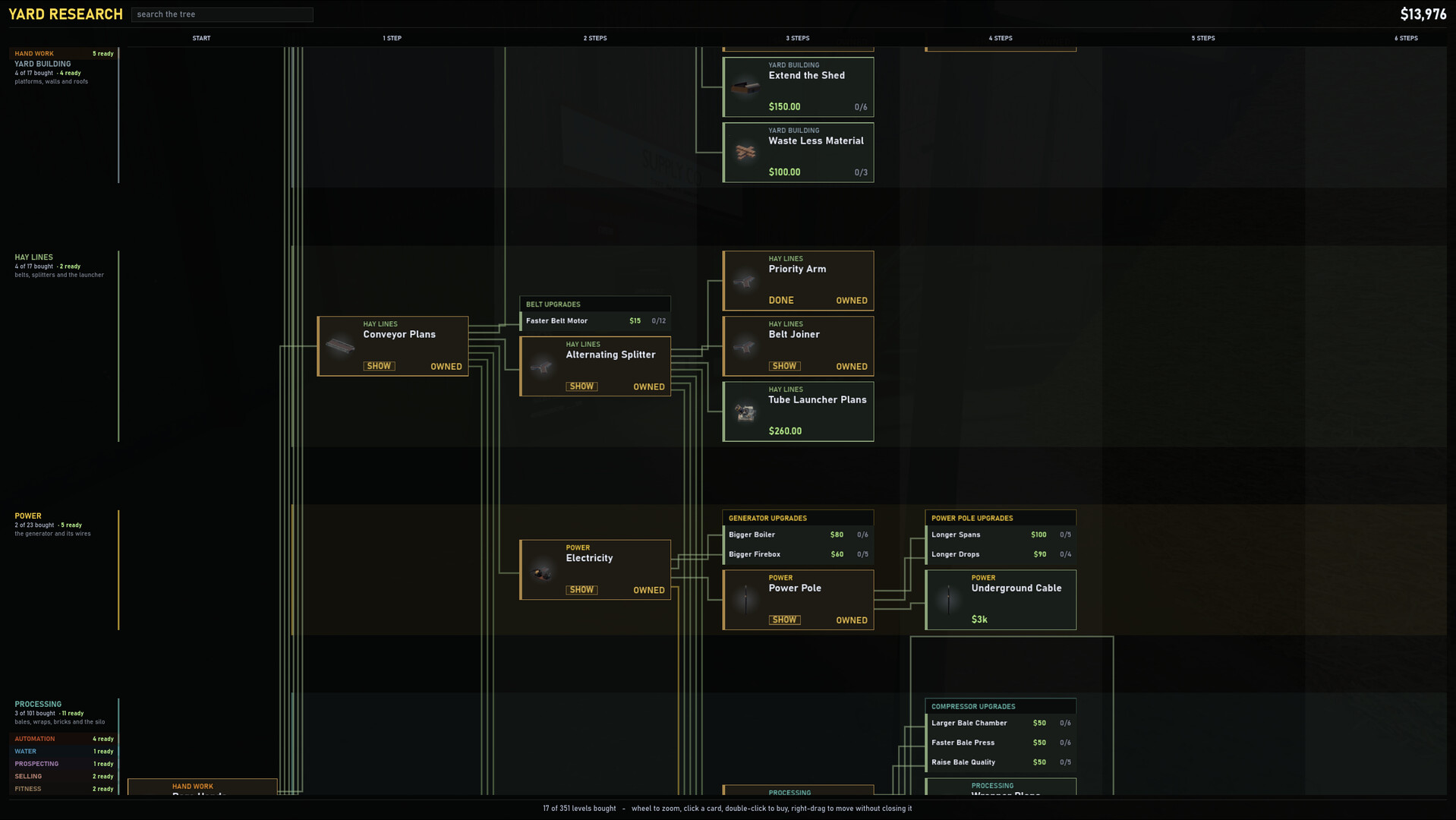
Read research as part of the purchase plan
The official technology tree has more than 300 upgrades covering new machines, production speed, efficiency, factory expansion and additional processing methods. The description does not provide the names, costs or prerequisites of every node, nor does it count the nodes accessible in the current demo. Those details and a complete unlock route are 待确认, even though the broad technology categories are established.
As a recommendation, connect a research choice to the purchase or routine you intend it to support and inspect the current prerequisite information. Reserve attention for the supporting parts of that plan, because an unlock alone does not explain an entire connected arrangement. The skill tree guide explains how to read the technology system without inventing character skills, passive points or a universal optimal build.
08
Reassess after one useful change
A practical progression recommendation is to change one meaningful part of your routine and observe how the wider operation responds before making the next large decision. Write down whether the original task became easier, whether another step now needs attention, and what information is still missing. This is a suggested decision method, not a measured promise that one purchase will always produce a particular result.
A purchase note can record the purpose, the current requirement and the supporting items you still need to inspect. Keeping these together helps you compare a modest manual improvement with a larger production plan on the basis of what each would enable. It also gives the next decision a clear starting point, because you can revisit the remaining task instead of rebuilding the entire purchase plan from memory.
When your focus moves toward automated searching, inspect the haystack scanner guide and the current device description before incorporating it into the plan. When your focus stays on hay processing or sales, keep the next investment tied to that separate purpose. The official equipment names provide a direction of progression, while your available tools, requirements and observed needs determine a reviewable next step.
Questions
What players ask
Which manual tools are officially named?
The Steam description names shovels, buckets, wheelbarrows, pitchforks and vacuums as tools that help process hay manually. Their exact statistics and purchase order are 待确认.
What should I buy first?
A universal first purchase is 待确认. As a recommendation, identify the task slowing your current routine, then check the available option's description, cost and requirements before choosing.
Does the official list establish a full unlock sequence?
No. The description presents manual tools and later automation, but exact prices, dependencies and a complete build sequence are 待确认.